
- Online VoIP Comparisons since 2005
- 26.5+ Million page views: Testimonials
Residential VoIP service providers are the most popular choice for home phone services in 2026. Millions of homeowners have switched to VoIP from a regular landline service and enjoy significant cost savings, unlimited calling plans, and amazing calling features (such as call forwarding, call blocking, voicemail to email and more). We will help you find the best VoIP service for your home:
| Provider* | Highlights | Startup | Reviews | More Info |
|---|---|---|---|---|
|
|
|
30-day Money Back |
Read Reviews |
|
|
|
|
30-day Money Back |
Read Reviews |
|
|
|
|
15-day Money Back |
Read Reviews |
|
VoIP service simply enables your phone calls to be transmitted and received over your home Internet connection instead of your telephone landline. This is perhaps why some people refer to the service as being an Internet phone service or broadband phone service. This does mean though that you need a high speed Internet service to be able to use VoIP for your phone service.
From an end user point of view, the actual phone service works in the same way, you pick up the phone to answer a call or to dial a number just like with a landline service. Number porting means you can keep your existing phone number and simply switch it over to your new service provider. The residential VoIP providers take care of the call routing and you can call any destination and receive calls from anyone, just like with regular home phone service.
The only additional piece of equipment that you need is an Analog Telephone Adapter (also referred to as an ATA) that allows you to connect your existing telephone to your home Internet. This equipment is typically provided on a free lease basis from the home VoIP provider that you choose, or you can use you own device if you prefer. You can also use IP phone(s) instead of using the ATA with your existing analog phones. The sound quality is better but there is more up front cost as IP phones are more expensive than the ATA devices.
Yes it is really this simple. Just connect your telephone adapter to your home Internet by connecting a cable between it and your router or modem. Then connect your existing phone to the adapter and you should be good to go. If you decided to use your own adapter, you will likely be required to run a quick configuration script that is supplied by your service provider.
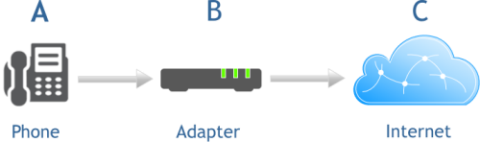
Here are just a few of the benefits and main reasons why it is worth considering VoIP for your home calling needs:
It is much cheaper than a regular landline - most providers offer unlimited calling plans (including long distance) in the USA and Canada for under $10 per month. There are also some great promotional deals available such as 2 year specials that cost around $6 per month (includes all your calling). Comparing this to a regular PSTN (landline) phone service that can cost in the region of $60 per month can result in savings of over $500 per year for many home phone users. If you also regularly call International numbers you can save even more, with rates typically starting from around 1 to 2 cents per minute to many countries.
The majority of plans are loaded with a great selection of features that can come in handy when you are making or receiving calls. Many providers offer over 30 features included in the low monthly fees. These include basic call management features such as call waiting, call forwarding, call blocking, caller ID name, do not disturb, and voicemail. More advanced features such as the voicemail to email feature let's you access your messages at anytime, even when you are away from your home, simply by checking your email inbox. Distinctive ringing, additional virtual numbers, and Smartphone Calling App's are other examples of more advanced features that can be useful.
There are hundreds of residential VoIP service provider choices, making it easier to find the best option for your exact needs. This also benefits the consumer as many keep their prices lower to compete with each other.
The following table provides a high level summary of how residential VoIP service compares to other alternative solutions for home phone service. The table compares this service to a regular landline, a bundled phone service from a cable company such as double or triple play, and a cell phone service. The cell phone is included as some people decide to just get rid of their wired phone and use their cell phone for all calls. Free services such as Skype are not included as they are not effective, like for like, landline replacements in our opinion.
| Feature | VoIP | Landline | Triple Play | Cell Phone |
|---|---|---|---|---|
| Free Setup Installation |  |
 |
|
|
| Low Cost Options (<$10/mo) | |
|
|
|
| Large number of calling features included | |
|
|
|
| Unlimited Nationwide calling packages available | |
|
|
|
| Free International Calling plans available | |
|
|
|
| No additional hidden fees (besides tax) | |
|
|
|
| No contract plans available | |
|
|
|
| Portable (e.g. can take on vacation) | |
|
|
|
| Monthly or Yearly plans available | |
|
|
|
| Digital Voice Quality | |
|
|
|
| No Equipment Fees | |
|
|
|
| Not dependant on wireless/cell signal strength | |
|
|
|
| Easily change service provider | |
|
|
|
| Equipment does not require frequent charging | |
|
|
|
There are a few disadvantages of using VoIP for your home phone service that you should be aware of.
One advantage of the traditional landline services is that electrical power is sent over the telephone wires so your phone service is isolated from your house power. This meant that your phone service would continue to work if your house power went out. However, with VoIP, power is used not only for the ATA, or the IP phone, but it is also used for your Internet modem and router devices. No power also typically means no Internet service.
There are some solutions to this issue if you have concerns. The most obvious is to utilize Uninterruptable Power Supplies (UPS) for those short outages, or a generator if you live somewhere where outages are more common (and for your fridge!). With so many people having cell phones these days most people will not be too concerned with this issue, especially when they consider the money they are saving. Most services include a call forwarding feature so you can always set that up to go to your cell phone so you do not miss important calls.
A high speed Internet connection is required to "carry" your calls so if you have an Internet outage (or your ISP has an outage) then your phone service will not work. Internet services have improved significantly in the last few years and outages tend to be much less common than they use to be. Again, if you have a cell phone then this may not be an issue for you.
E911 (Enhanced 911) is a little different to traditional 911 services and is something that you should be aware of. With E911 you need to provide your home address, and this information gets passed to the emergency services if you dial 911. The concerns are that if you have a power outage or an Internet outage then you will not be able to dial 911. If you have a cell phone then you can dial 911 from your device. If you are ONLY reliant on VoIP for your phone service you should be aware of this situation.
Now that you know what VoIP is, what a typical set up looks like and the benefits and down sides, the next step is to choose a provider. Below we outline a simple 3 step process that will help you make the right decision.
Next we break each section down into more detail and show you ways in which we can help you with various guides, articles, and custom tools.
If you have got this far then your understanding of VoIP has already started with the above introductions, setup and benefits sections. We provide many guides and articles that address many frequently asked questions. This is an important step and foundation to be able to start comparing providers with your needs as well as against each other.
As always the best place to start is at the beginning! The following buttons provide access to some of our best guides and tools for getting started with VoIP. These articles give a great background into VoIP, help you understand all the basics, and answer most people questions. The VoIP/Speed test tool performs a test of your Internet connection and provides a great indication of how well VoIP will work at your home. We highly recommend running this test.
Below are some of our most popular articles as well as a link to access our articles directory, from which you can browse all related articles.
The interest that VoIP technology is generating for consumers and businesses alike, is creating a high level of demand that is being addressed by more and more providers entering the market. Choosing the best home phone service can now be a challenge as it can be difficult to compare providers that have different pricing structures, different features and different contract terms. Many residential providers names are becoming familiar in the home, such as Vonage, MagicJack and Ooma. Vonage, one of the more expensive options today, is popular due to its unlimited international calling feature. Evaluating Vonage competitors can save you even more money depending on your exact needs.
Performing a side-by-side comparison provides a way for home phone users to find the best VoIP providers available at the lowest prices. The popular providers comparison table above and our comparison tools provide our visitors with what they need to compare the options, and also find the lowest prices available today.
We have performed various comparisons between different popular providers and also created guides detailing competitors of various popular providers. If you are considering any of these providers then the below guides can be a great resource before making a selection.
If you want to compare pricing for multiple residential service providers you can use our Home Phone Rates Tool. Please note that the pricing does not include additional fees like sales tax, regulatory fees and any other taxes/fees that may be relevant to your location. These tend to be the same for each provider as it is based on location, however, some providers may include additional "recovery" fees for the overhead involved in state and regulatory compliance (e.g. FCC reporting compliance).
For International calls use our International rate comparison tool to find the lowest cost provider rates for over 230 countries across the World.
Step 3 is all about reviews. However, as this section is about comparison we are introducing our Ratings Comparison Tool in this section. This tool allows the ability to select from a list of service providers and compare user review ratings side by side. You can also select specific rating categories for a seletion of providers and visually compare in a graphical representation.
Checking online user reviews are a main part of most peoples buying process these days. Why should getting VoIP service be any different? We have received thousands of user submitted reviews and we have performed our own review of over 30 top providers. Why not check them out before you make your final decision.
Residential VoIP reviews submitted by real users can be a great tool when trying to decide which provider is the best choice for you. Each review includes ratings for various aspects of the service, such as sound quality, features, customer service and more, as well as their personal comments based on their experience of the service. Reading reviews is an essential part of the decision making process.
For each of the providers in the table below we have performed our own editor service review. We provide an overview of what we think are the good things and the bad things, as well as discuss the bottom line. This helps provide another data point for your selection process research.
The following table, in chronological order, provides access to over 30 of our most popular reviewed providers, including our own WhichVoIP editor review and thousands of user submitted reviews. For business providers check out our Business VoIP Reviews.
292
User Reviews
4.8/5
Average Rating
97%
Recommended
23
User Reviews
2.9/5
Average Rating
52%
Recommended
136
User Reviews
4.2/5
Average Rating
86%
Recommended
9
User Reviews
4.4/5
Average Rating
89%
Recommended
81
User Reviews
3.1/5
Average Rating
51%
Recommended
68
User Reviews
2.2/5
Average Rating
26%
Recommended
20
User Reviews
4.1/5
Average Rating
80%
Recommended
56
User Reviews
4.3/5
Average Rating
79%
Recommended
1
User Reviews
4.6/5
Average Rating
100%
Recommended
46
User Reviews
2.5/5
Average Rating
39%
Recommended
38
User Reviews
2.1/5
Average Rating
34%
Recommended
0
User Reviews
NR/5
Average Rating
-%
Recommended
6
User Reviews
3/5
Average Rating
50%
Recommended
9
User Reviews
3.7/5
Average Rating
67%
Recommended
1
User Reviews
3.8/5
Average Rating
100%
Recommended
124
User Reviews
2/5
Average Rating
15%
Recommended
105
User Reviews
2.6/5
Average Rating
23%
Recommended
36
User Reviews
4.9/5
Average Rating
97%
Recommended
194
User Reviews
2.8/5
Average Rating
32%
Recommended
1
User Reviews
5/5
Average Rating
100%
Recommended
195
User Reviews
2.7/5
Average Rating
35%
Recommended
1
User Reviews
1/5
Average Rating
0%
Recommended
31
User Reviews
2.7/5
Average Rating
32%
Recommended
12
User Reviews
2.8/5
Average Rating
67%
Recommended
44
User Reviews
3.7/5
Average Rating
68%
Recommended
9
User Reviews
3/5
Average Rating
44%
Recommended
262
User Reviews
4.1/5
Average Rating
68%
Recommended
3
User Reviews
2.1/5
Average Rating
67%
Recommended
18
User Reviews
1.5/5
Average Rating
17%
Recommended
15
User Reviews
2.9/5
Average Rating
33%
Recommended
8
User Reviews
2.5/5
Average Rating
38%
Recommended
56
User Reviews
2.6/5
Average Rating
25%
Recommended
7
User Reviews
2.2/5
Average Rating
14%
Recommended
237
User Reviews
3/5
Average Rating
37%
Recommended
70
User Reviews
3.9/5
Average Rating
69%
Recommended
11
User Reviews
4.8/5
Average Rating
91%
Recommended
36
User Reviews
2.8/5
Average Rating
47%
Recommended
94
User Reviews
4.5/5
Average Rating
88%
Recommended
73
User Reviews
4.4/5
Average Rating
82%
Recommended
3
User Reviews
4.9/5
Average Rating
100%
Recommended
0
User Reviews
NR/5
Average Rating
-%
Recommended
508
User Reviews
3.1/5
Average Rating
44%
Recommended
10
User Reviews
2.7/5
Average Rating
30%
Recommended
The reviews accessible from this page have been submitted through the review form on WhichVoIP by users of this site. We use various techniques to monitor validity of the submissions in line with our Review Guidelines. These techniques work well but we cannot guarantee 100% verification that all submissions are from real users.
If you currently use a VoIP provider then please write a review of your experience to help others make an informed decision.
If you cannot find an answer to any of your specific questions, access our discussions page and send us your question. We typically answer within 24 hours. The discussions page also displays the most recent questions we have received along with answers. You can search our questions archive to find similar questions received in the past.
We also partner with providers in other countries:
If you have a small business or work for a small business that would like to save money on phone bills we can help. Simply complete the form below to get FREE quotes or visit our Business section for more information.
© 2004-2026 WhichVoIP.com