
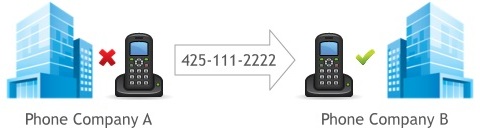
Local number portability, often referred to as simply LNP, is a very important service offered by nearly every phone service provider, including VoIP companies. Whether for business or residential service, a consistent phone number is important for communication continuity. Like a permanent address, a phone number serves as a piece of identifying information crucial for contacts to connect with you or your business.
On the surface, porting a number seems to be a simple process. However, what lies beneath is a mildly convoluted process of exchanging rights to the number between phone providers. In this article, we will explain the process behind number porting and look at different rules that govern the United States and Canada, where this subject projects a high level of interest.
Phone Number Refresher
First a quick refresher, a phone number is a unique address designation much like a product serial number, vehicle VIN number or an external IP address in the sense that the number is exclusive. Technically speaking, a telephone number is defined as a LRN or Local Routing Number. This 10-digit code, represented by the notation NPA-NXX (called a central office code) defines the location of the exchange. The first six digits route the call to the appropriate local area and the last 4-digit line number is the actual customer's unique number (often represented by XXXX) that ultimately enables completion of the call.
Think back to the days of switchboards where operators would physically connect switches at exchange centers to complete a call circuit. In the past, a phone line was directly associated with a geographic location like a home or business address. In some ways, this still holds true today. However, this format now also includes mobile phone networks called the MTSO (Mobile Telephone Switching Office) and VoIP service providers and due to the nature of these services, you are no longer tied to a specific geographic area.
Much like external IP addresses for network resources, LRNs are assigned to providers in large blocks and then issued to customers. Unused numbers are aggregated by an organization called the Number Portability Administration Center (NPAC). The NPAC started in 1997 and is a joint effort by the Federal Communications Commission (FCC) and the Canadian Radio-television and Telecommunications Commission (CRTC) to help make number porting between carriers a possibility.
Number Porting is Relatively New to Telecom
In the past, AT&T had complete control over all phone numbers. Before 1984, this was not a problem when AT&T completely monopolized the industry due to majority ownership of the Bell System. Of course, business of such magnitude is crippling to any industry. It was AT&T that proposed the dissolution of the company that ultimately became a divestiture resulting in seven, independent regional carriers.
As the companies operated independently, this resolved many problems but a new set of issues stemmed from current competition practices. Eventually, the FCC had to intervene because of various anticompetitive proceedings by these carriers that eventually led to an overhaul of telecom law outlined in the Telecommunications Act of 1996. One year later, when the NPAC formed, interconnectivity issues were fixed, namely number porting and other benefits were observed such as enablement for any entity to enter the communication industry.
Realizing that the demand for number porting would only grow over time, the FCC appointed a neutral third party to oversee NPAC operations. The company Neustar was designated to oversee the NPAC and still does so today.
How a Number Transfer Actually Works?
It seems like the process should be as simple as signing a title to a buyer similar to when selling a used car. In reality, the process is simple but administrative initiatives from both the old and new service provider must occur for the port to transpire. In short, a request from the new provider commences an action that eventually results in the old provider releasing the number for the new service.
Note: it is very important that a customer does not terminate service with the old provider before the transfer completes, as otherwise the customer is at risk of losing the number altogether.
Of course, the whole process is a little more involved, requiring completion of several steps before the number finally transfers to a new provider. Behind the scenes, a number port carries out as per the description provided by the NPAC:
- The customer requests to use an existing phone number with a new provider who submits a request to the old provider, hence initiating the process.
- The former provider confirms the customer’s information then relays this information back to the new provider.
- At this point, the new provider sends information gathered to the NPAC – this commences the actual number port. In certain scenarios, the old provider may veto the process.
- When the NPAC creates the port, notification is sent to the new provider which can now request activation.
- After the NPAC receives acknowledgement from the new provider, the port becomes active and the information enters a database, accessible to all service providers, so when the number is dialed, all carriers have the necessary information to appropriately route a call to the customer.
Key Points When Porting Numbers in the US and Canada
Thanks to the NPAC, porting numbers is simple for the consumer or business. For the most part, the only requirement for the customer is furnishing the correct information; this usually includes the phone number, account number for the old service provider, service address (or address on file for mobile and VoIP accounts) and password, if applicable. Though porting is usually a pain free process, there are certain points to keep in mind before transferring a number to a new carrier:
- Sometimes there are fees. The NPAC, FCC and CRTC do not assess fees, as some mistakenly believe. Rather, the new provider collects these fees as a service charge. Essentially, a company justifies these fees to recovering the labor expended for processing these changes. Note that a new provider cannot refuse a number port for not paying a porting fee, at least up front.
- Outstanding charges do not matter. Fees from an old service provider cannot prevent this entity from releasing a number to a new provider. A phone number is considered property of the account holder so regardless of the balance owed, an old provider must release the number. It is up to the old provider as to whether or not any termination fees will apply to the final account balance – this information is usually outlined by a contract from this provider.
- Duplicating numbers is not allowed. Just because you or your business legally owns a phone number does not mean another provider can activate this same number on a new account.
- Porting periods can vary. Technically, the FCC mandates that "simple" ports, i.e. any combination of one number from a fixed line, VoIP line or mobile to the same kind of service or intermodal transfer between the previously mentioned communication services, to be completed in one day. Some companies, especially VoIP providers, may take longer to complete the actual port, sometimes as long as 2 to 4 weeks.
- 911 services may be affected for a short time. During the porting period, there is a short length of time where a phone number could be associated with more than one line or device. Current emergency service technology allows physical location tracking in most cases, however, incorrect information could be acquired from a dispatch center during the porting process. In rare situations, dire consequences could result because an emergency responder received incorrect location data.
Local Number Porting Specific to Canada
Canadian providers are subjected to the same requirements as the United States, though a few differences do exist. Prior to 2007, LNP was more of a suggestion than a requirement despite the fact that the NPAC extended its reaches to Canada in 1998. However, some Incumbent Local Exchange Carriers (ILEC) were refusing to port numbers to other competing providers.
In 2007, the CRTC created a policy known as the Wireless Code. Companies are now required to comply with LNP requests whether those be wired or mobile. This act ultimately enforced all providers to comply with number transfers except for the following, select cases.
- Very small, independent providers serving local regions are not forced to comply with LNP requests. It is primarily this use case that causes problems for some of the visitors on WhichVoIP.com. In fact ever week we see comments on our site from Canadians having difficulties transferring their numbers to a VoIP provider. Typically this is on the residential side as opposed to the business side, although it does happen.
- The 600 area code typically reserved for non-geographic services (e.g. satellite phones) are not required to be portable but are transferable to providers of the exact same kind.
When Problems Arise
The most common issues with number porting occur with VoIP providers. As VoIP is defined as an information service, these companies are not subjected to the same regulations as mobile or traditional Plain Old Telephone Service (POTS). Fortunately, most companies recognize the value in number porting so this service has become highly available across the industry.
If a company does not comply with an LNP request, it is possible to take action by contacting a governing agency. Both the FCC and CRTC have publicly accessible contact information for filing complaints to resolve porting issues, among others problems.
In the US
A consumer can contact the FCC to complain. Call 1-888-225-5322 or complete the FCC online complaint form.
In Canada
Complaints against Canadian communications are made to the Commissioner for Complaints for Telecommunications Services (CCTS) by calling 1-888-221-1687 or completing the CCTS online complaint form.
Useful Tools and Resources
At WhichVoIP we use a few tools when our visitors ask us about Local Number Portability for specific numbers. These tools tend to work in most cases so if you enter your phone number they will typically tell you, with reasonable accuracy, whether you can perform a number port for your existing phone number to a VoIP provider.
- Callcentric LNP Tool - Very useful tool for most US and Canadian residential phone numbers.
- 8x8 Number Transfer Tool - Great tool for US businesses.
- VoIP.ms Number Portability Tool - Check US or Canadian phone numbers.
- Number Portability Administration Center (NPAC) - Learn more abour porting numbers.
- FCC Portability Guide - The process of porting a number.
- CRTC Number Porting by Province - See if your local exchange in Canada is regulated by the CRTC or not (i.e. can you port).
Final Thoughts
Local number porting is a relatively straightforward process these days regardless of whether you are dealing with a traditional landline, VoIP or a mobile phone number. Most ports are successfully completed in less than one day and other than a few issues in certain areas of Canada, it is rare for a transfer to not be completed. Take advantage of the tools indicated in this guide and get a feel for any issues you could up against during the port, and if you run into problems at least there is a governing agency to complain to and help fight your case.
VoIP has helped create a highly competitive environment when shopping for a new phone service and thanks to LNP there are few stumbling blocks preventing you from getting a great deal. Take a look at our residential and business sections to see the great deals available to consumers and businesses.
 PREV
PREV