
- Online VoIP Comparisons since 2005
- 26.5+ Million page views: Testimonials
If your business does not already use SIP trunks for phone calls then it is likely worth a few minutes of time to use the best SIP provider comparison table below to get pricing and/or access user reviews, or request free price quotes to determine the potential savings. Use our free quote tool below to get comparison price quotes with one simple form!
| Provider* | Highlights | Startup | Reviews | More Info |
|---|---|---|---|---|
|
|
|
Sign up for Free today |
Read Reviews |
|
|
|
|
30-day Trial |
Read Reviews |
|
Session Initiation Protocol (SIP) Trunking is a relatively simple way of modifying your business Private Branch Exchange (PBX) box and giving it the ability to make Voice over Internet Protocol (VoIP) phone calls. SIP trunking allows you to "overlay" your data connection to the Internet with a voice connection that acts simultaneously with the data connection.
The major advantage to this is that it eliminates the need for Public Switched Telephone Network (PSTN) connections, traditionally referred to as "phone lines", from the standard array of phone companies. By skipping out on the PSTN, you also skip out on the standard connection and per-minute fees charged by the phone companies.
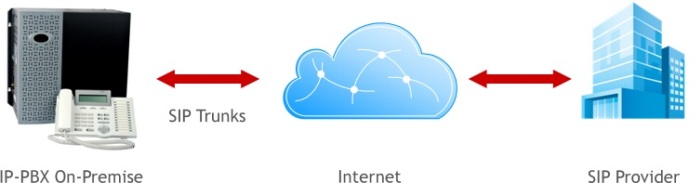
SIP trunking starts at the IP-PBX. The PBX is connected to the internal network (Ethernet) and the internal network is then connected to the Internet via a service provider. The service provider will have an interface to the PSTN, although the business need not be concerned with that. The end result is that the person using an IP phone is able to call any number, anywhere.
Ultimately, trunking eliminates the need to deploy alternative technologies such as PSTN gateways or PRIs (Primary Rate Interfaces). In general, this service is a far less costly solution, highly efficient, and easier to manage, since fewer pieces of hardware are required. Since SIP trunks can be purchased incrementally, cost savings is increased compared to PRIs, which must be purchased in groups of 23 channels at a time.
If a business is using a hosted VoIP solution then trunking is unnecessary. Should a business make the decision to use an on-premises solution, then trunking should be seriously considered.
There was a time in which telephony call quality in general was low compared to a standard line, but that time has long since passed. Today's SIP calls are as clear or clearer than standard phone lines in almost every case, provided they were properly setup. Improperly trunked SIP calls can suffer packet loss and latency problems that will reduce quality. As phone calls are converted in to a digital format many phones and service providers support High Definition (HD) sound.
To get the best call quality, you'll need a network backbone with minimal latency, minimal packet loss, and low jitter.
If you have an IP-PBX, it is. If you have a standard PBX then it may still be compatible, but it will need an Interface card known as a gateway.
That depends a lot on how many calls your business makes, at what time, the distance of the call, and how long the calls last. The best option is to get quote requests and compare with your recent bills. In most cases, even with a relatively small call volume, you'll be surprised at the savings which are typically in the 50% to 70% range.
SIP trunking is the heart of what makes your VoIP system talk to the outside world, or the Public Switched Telephone Network (PSTN). There are alternatives, including using a hosted VoIP environment, and deploying PRIs (Primary Rate Interfaces), or of course, just using the Public Switched Telephone Network (PSTN) and not using VoIP at all. However, VoIP delivers so many advantages in terms of cost and extra features, many businesses are finding it to be an essential component of their telecommunications environment. As such, trunking is often a major consideration when an on-premises VoIP deployment is made.
When compared to a conventional analog circuit, SIP trunking affords the same level of quality at a much lower price per circuit. Further, when compared to PRIs, trunking affords a similar price performance advantage. PRIs must be purchased in combinations of 23 channels, whereas SIP trunks are purchased incrementally, which gives the enterprise a great opportunity to purchase only as much as is needed. For more on SIP versus PRI check out this article.
It is not necessary to purchase a SIP channel for every extension, rather, only enough to accommodate simultaneous calls. For example, if an enterprise has 100 telephone extensions, but at any given time only 25 people are on the phone, then only 25 SIP trunks are necessary to accommodate normal traffic. Some oversubscription to that figure would be a wise investment, but even with oversubscription, this solution affords a much more efficient use of resources.
Scalability is an issue with any telecommunications environment and trunking allows for easy additions. When additional extensions or higher phone traffic demand more trunks, they can be purchased incrementally, one at a time, on an as-needed basis. A PRI solution on the other hand, has a 23-channel incremental purchase requirement, which may mean that businesses would find themselves buying more channels than is really needed. Another comparative advantage between trunking and a PRI solution is implementation time; it may require as much as 30 days to provision PRI channels, and it requires an on-premises visit. SIP trunking can usually be rolled out remotely within 24 hours with no truck roll required.
The capital costs of switching to a SIP service will vary dramatically based on a few factors. First of all, does your business already have an IP-PBX system installed? If so you're in luck as you can attach a SIP trunk to your IP-PBX box quickly and inexpensively, and you'll be making calls in no time. If not, you'll have to choose between installing an IP-PBX (not an inexpensive prospect) or using your old (non-IP) PBX, which removes much of the functionality of the SIP service, but still keeps the most important aspect of lowering your phone bills.
Your calling features almost all originate in your IP-PBX in the first place, so trunking your SIP service onto it means you still get to have all of your old toys.
The first major point to be aware of is that not all SIP Trunking Providers are identical, as they package (and price) their services quite differently, and the entire technology is just new enough that there is not yet a general industry standard. That means that each SIP provider will have their own technical methodology, their own standard and optional services, and their own ideas of what your business can benefit from. When talking to SIP Trunking Providers be prepared to answer 3 main questions, which we expand on below.
The maximum number includes the number of incoming and outgoing concurrent calls that you need to support. This number could be limited by the PBX (phone switch) you have installed at your place of business, but it's more likely to be soft-capped by the size of your business in general. If you are currently utilizing PSTN T1 voice lines then the amount of money you save will be moderate if you need only 20 simultaneous calls, but it will be much greater if you need to support 25 for example. That's because your typical dedicated PSTN T1 voice line supports exactly 23 simultaneous calls, break that hard limit, and you are paying for a second T1 line, doubling your base expense. SIP trunking doesn't have that "quantum leap" effect, you pay for exactly the number of connections you need, no more or less, and you can expand the cap as your business grows.
Sidenote: Many modern PBXs have powerful features that might cause you to underestimate the number of phone lines you need. For example, the FindMe/FollowMe feature of your PBX might take an incoming call and simultaneously forward it to your cellphone, home phone, and off-site business phone, using four connections (one incoming and three outgoing) at the same time. Obviously, if this should happen to multiple workers at once (say, the boss sends out a voice blast to his entire department at once), the effect can be profound.
Incoming phone numbers can be very useful to a business of any size, for example, do you want each employee to have their own phone number? Or do you want to separate sales promotions by phone number so you can easily judge which are the most productive? Keep in mind that many companies only offer incoming phone lines that are locally available, for example, you can only call into them from a specific city. This can be both a boon and a bane, for while your customers can only reach you from their homes on your local city line, if you purchase a line localized to another city, you can give your customers there the impression that you have a presence in their cities.
If you've already upgraded to an IP-PBX, a SIP trunking service can connect directly to your PBX, provided the two are interoperable; remember that there are not a lot of industry standards in this area as of yet. Each IP-PBX manufacturer and SIP provider has their own mostly-unique take on the technology, so be prepared to give your IP-PBX's make and model number to the provider to verify interoperability (some examples are Asterisk, 3CX, Cisco Callmanager, Allworks & Shoretel).
If you're still using a legacy PBX, it is still an option. However, many of the features, particularly of the Unified Communications variety, won't work. You'll still get to make free phone calls and some of the Web-based features of your service, but you'll probably want to upgrade to an IP-PBX and IP phones as your current equipment needs replacing.
This answer starts with knowing the answer to the above questions. SIP calls use your Internet connection, so you need to add your current maximum Internet bandwidth use (you can find out with a quick call to your ISP), plus enough to support the maximum number of simultaneous calls you have to support. There are quite a few factors that go into how much bandwidth each call will require, but you can generally estimate 92 Kbps each and be very safe. If you have a high call volume business, you might want to ask your ISP if they have a service that can dynamically allocate bandwidth, but either way, if you don't already have a lot of excess bandwidth going unused, you can expect to need to upgrade your bandwidth when making the switch over.
There is tremendous variety in service providers today. Some may offer you an Internet connection, acting as both ISP and SIP provider. Some provide expansive call-quality and/or equipment-reliability guarantees. Some give you powerful diagnostic tools to help you address any call-quality issues on your own. You probably won't find it all under one roof, so deciding what your dealbreakers are ahead of time is critical.
IP telephony in general has one major weakness: faxes. Every service provider has their own solution to this dilemma, ranging from "don't use them" to very elaborate Integrated Access Devices (IADs) that they install on your premises with analog ports that can support fax machines. In many cases, it's actually wise to keep a single traditional PSTN line in order to run faxes and make emergency calls if for some reason your power goes out or your Internet connection is otherwise unavailable. Alternatively, consider moving to an Online Fax Service and say goodbye to that old fax machine!
Quality of service (QoS) must be taken into account. Given the right circumstances, SIP trunking can deliver equal quality to a PRI (Primary Rate Interface) connection.
IP networking is by nature a "best-effort" proposition, with bursty traffic flows and the potential for rerouted traffic or lost packets. When IP packets are lost, the network sends the packet again, which in the case of normal Internet traffic, is not problematic. But when that occurs with time-sensitive packets such as voice transmissions, the result is a loss in voice quality. Advances in the Internet Protocol and the Internet itself, as well as in VoIP equipment, have in general been able to overcome much of that, and today, it is possible to enjoy VoIP calls that have the same voice quality as the ordinary PSTN.
The most common approach to QoS in VoIP installations using SIP trunking is to add more bandwidth, and having "fat" pipes is always recommended for VoIP users. Beyond that, VoIP and data traffic may be split into two distinct connections, which avoids any potential congestion on the internal network. If VoIP has its own dedicated circuit, then QoS is less of an issue, since there is no other traffic competing for bandwidth.
Furthermore, an on-premises QoS router will address priority issues, assigning priority to VoIP packets over packets that can sustain delay better. This will also lead to better "traffic shaping" which also helps to ensure that inbound VoIP packets have enough capacity. Alternately, a firewall that is SIP-aware has a wide variety of techniques that can help shape traffic and ensure QoS for VoIP packets, including "throttling," which simply holds back ordinary traffic to allow VoIP traffic to flow through. Think of it as a type of virtual traffic cop in your network.


The following provides links to SIP trunking related articles that may be of interest.
© 2004-2026 WhichVoIP.com